

News and Information
Leading photovoltaic glass companies are aggressively driving down prices, leading to a decline in gross profit margins.
Leading photovoltaic glass companies are aggressively driving down prices, leading to a decline in gross profit margins.
Release time:
2023-06-26
Source:
Reprinted from 36Kr
Author:
Times Finance
Photovoltaic glass is an important auxiliary material for solar modules. On March 27, Liu Jimao, founder of Hongyang Solar, told Times Weekly that in recent years, the installed capacity of photovoltaic systems has grown rapidly, driving a sharp increase in demand for photovoltaic glass.
As the overall supply and demand in the photovoltaic market return to balance, can Follett—the leading player in photovoltaic glass—continue to maintain a certain level of growth in the future?
On the evening of March 26, Follett (601865.SH) released its annual report, reporting that in 2023, it achieved operating revenue of 21.524 billion yuan, a year-on-year increase of 39.21%; and net profit attributable to shareholders of 2.76 billion yuan, up 30% year-on-year. The company plans to distribute a cash dividend of 3.8 yuan (including tax) for every 10 shares held by all shareholders.
This is the fifth consecutive year of growth in Follett’s net profit since 2018.
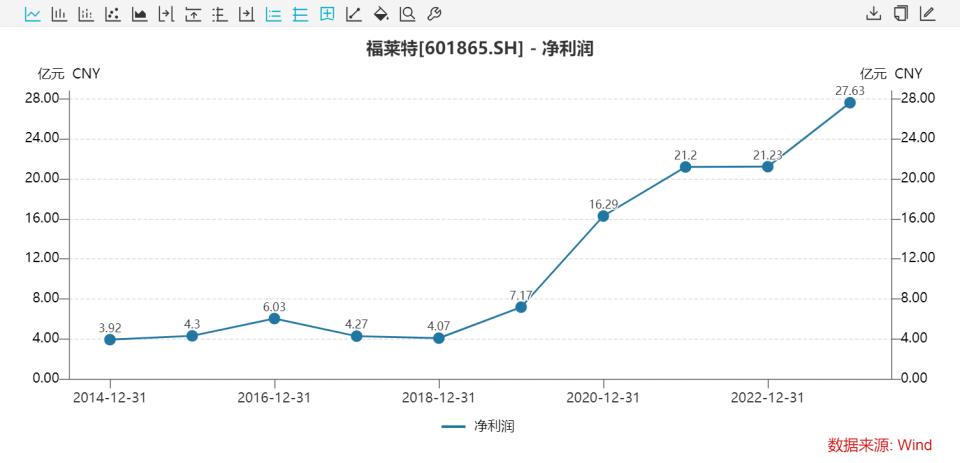
Image source: Wind
However, in 2023, the company’s photovoltaic glass gross profit margin declined significantly to 23.31%, a year-on-year decrease of 12.39%. “Affected by oversupply of glass and pressure on module production scheduling, glass prices plummeted in 2023, leading to a substantial year-on-year decline in Follett’s profitability,” stated Guojin Securities in a research report on March 26.
Profitability pressure on photovoltaic glass is increasing.
Publicly available information shows that Follett was listed on the Shanghai Stock Exchange in 2019. The company’s core business spans four major areas: photovoltaic glass, float glass, architectural glass, and home glass. Among these, the research, production, and sales of photovoltaic glass represent the company’s primary business. Its key customers include photovoltaic manufacturers such as Longi Green Energy (601012.SH), Jinko Solar (688223.SH), Oriental Rise (300118.SZ), JA Solar Technology (002459.SZ), and Zhejiang Chint New Energy.
Photovoltaic glass is an important auxiliary material for solar modules. On March 27, Liu Jimao, founder of Hongyang Solar, told Times Weekly that in recent years, the installed capacity of photovoltaic systems has grown rapidly, driving a sharp increase in demand for photovoltaic glass.
According to statistics from the National Energy Administration, China added 21.688 GW of new photovoltaic capacity in 2023, representing a year-on-year increase of 148.1%. Against this backdrop, Follett’s sales of photovoltaic glass saw a significant increase in 2023.
According to the annual report data, in 2023, Follett’s sales of photovoltaic glass reached 1.22 billion square meters, representing a year-on-year increase of 49.52%. Inventory decreased by 29.28% compared to the previous year. Meanwhile, the company’s revenue from photovoltaic glass increased by 43.82% over the previous year, and its revenue share has risen to as high as 91.4%.
Apart from photovoltaic glass, Follett’s revenue from furniture glass, architectural glass, and mining products decreased by 6.15%, 2.16%, and 0.92% respectively compared to the previous year, while revenue from float glass increased by 2.15% over the previous year.
From the perspective of gross profit margin, Follett’s photovoltaic glass, home glass, and architectural glass had gross profit margins of 22.45%, 11.52%, and 10.79%, respectively, down by 0.87 percentage points, 6.44 percentage points, and 3.29 percentage points, respectively. The gross profit margins for float glass and mining products were -3.61% and 26.44%, respectively.
As for photovoltaic glass alone, its gross profit margin has generally been on a downward trend in recent years, putting increased pressure on profitability.
In response, on March 27, Qu Fang, an investment advisor at Wanlian Securities, told Times Weekly that in 2023, the photovoltaic glass industry is facing increasing profit pressures, primarily due to the following factors.
“In recent years, the prices of photovoltaic glass raw materials such as calcium carbonate and soda ash have experienced significant fluctuations, sometimes even rising sharply, which has affected the production costs of photovoltaic glass. At the same time, with the rapid development of the photovoltaic industry, the production capacity of photovoltaic glass is also steadily expanding, intensifying market competition. To compete for market share, manufacturers may lower their prices, thereby impacting profitability.”
“In addition, government support policies for the photovoltaic industry could intensify market competition, thereby impacting the profitability of photovoltaic glass companies,” Qu Fang further stated.
In fact, Follett also mentioned in its annual report that, due to rising costs of soda ash and natural gas—and relatively stable glass prices—the industry’s profitability has hit a low point. In 2023, the pace of capacity expansion for photovoltaic glass slowed significantly, and market supply and demand have gradually begun to balance.
Regarding production capacity, Follett stated, “As of December 31, 2023, the Group’s total production capacity stood at 20,600 tons per day. The Anhui Phase IV project and the Nantong project together have a combined daily melting capacity of 9,600 tons per day, and are expected to begin operations this year. Meanwhile, the Group plans to invest in the construction of photovoltaic glass furnaces in Indonesia to meet the demand for photovoltaic glass in various countries and regions.”
Or usher in a new cycle.
Regarding the overall trend of photovoltaic glass in 2024, industry insiders generally expect supply and demand to tighten further, potentially ushering in another round of price increases for photovoltaic glass.
According to data released by the Ministry of Industry and Information Technology on the 21st, from January to February 2024, China’s cumulative output of photovoltaic rolled glass reached 4.509 million tons, an increase of 27.4% year-on-year. Of this total, February’s output was 2.227 million tons, up 32% year-on-year.
In terms of prices, during January and February, the average prices of 2-mm and 3.2-mm photovoltaic rolled glass were RMB 17.2 per square meter and RMB 25.5 per square meter, respectively, down 9.3% and 0.2% year-on-year. In February, the average price of 2-mm photovoltaic rolled glass was RMB 16.9 per square meter, a year-on-year decrease of 8.6%, while the average price of 3.2-mm photovoltaic rolled glass was RMB 25.2 per square meter, remaining unchanged from the previous year.
According to CITIC Securities, the current photovoltaic glass industry—with a capacity of approximately 100,000 tons per day—can barely meet the rigid production demand for modules, which stands at around 55 GW per month, making the supply-demand balance highly fragile. As downstream module production schedules have exceeded expectations, photovoltaic glass inventories have been rapidly depleted in the first quarter of 2024. Our analysis suggests that starting from the second quarter of 2024, photovoltaic glass capacity may once again fall short, leading to a significantly tighter supply-demand dynamic and potentially triggering a new round of price increases.
HuaFu Securities’ view indicates that the industry currently has approximately 101,000 tons/day of operating capacity, with 4,750 tons/day of newly commissioned capacity and 3,200 tons/day of capacity undergoing cold repairs in 2024. The new capacity added in 2024 will be concentrated among the leading players, bringing the nominal capacity to around 120,000 tons/day by year-end. On the demand side, PV module production schedules reached a new high in March, reflecting continued strong demand. Considering the capacity ramp-up cycle, there is potential for a mismatch between supply and demand. On the cost side, soda ash prices are already at low levels and have further room to decline, while natural gas prices have already fallen from their peak following the end of the heating season. With both supply-demand optimization and cost improvements, we believe that glass prices and volumes are poised for continued growth in 2024.
Qu Fang also noted that the two leading photovoltaic glass manufacturers currently account for 60% of the market share, giving them considerable control over market prices and supply-demand dynamics. “Throughout 2024, the supply of photovoltaic glass will remain relatively tight, and prices are expected to continue rising further. The overall production capacity for the year is projected to stay at around 130,000 tons per day.”
In the secondary market, as of the close on March 27, Follett rose by 1.39%, closing at 29.13 yuan per share.
According to the latest data from Wind, UBS AG (Swiss Bank Corporation) has now dropped out of the top ten shareholders of Follett.
It is understood that UBS AG, a qualified foreign institutional investor (QFII) and Europe’s largest financial group, manages 26% of global cross-border wealth, and its investment activities in China have consistently attracted close attention.
Judging from UBS AG’s investment activities over the past few years, the new energy sector has become its latest key focus for market deployment in China. The business areas involved span multiple sub-sectors, including lithium-ion cathode materials, on-board power supplies for new-energy vehicles, vanadium batteries, and thin-film solar cells.
In August 2023, UBS AG became one of Follett’s top ten largest shareholders, holding a 1.22% stake. One quarter later, UBS AG dropped out of the top ten.