

News and Information
Ge Bija: The dawn of optical glass is upon us—has the “little giant,” which just passed its review, successfully “borrowed the east wind”?
Ge Bija: The dawn of optical glass is upon us—has the “little giant,” which just passed its review, successfully “borrowed the east wind”?
Release time:
2023-06-26
Source:
Reprinted from 36Kr
Author:
Pinecone Finance
As intelligent new technologies continue to evolve, optical components—essential parts in most applications—are inevitably keeping pace with the changing times.
As the “main battleground” for serving innovative small and medium-sized enterprises, the Beijing Stock Exchange seems to be gradually gaining widespread attention this winter. According to available data, in December last year, the Beijing Stock Exchange received 44 applications for IPOs, while the Shanghai and Shenzhen stock exchanges combined received only 23 during the same period.
Meanwhile, the secondary market has also shown a remarkably strong response. According to data from Open Source Securities, the average price increases for new stocks listed on the Beijing Stock Exchange in November and December were 100.36% and 135.69%, respectively.
Such a “heated” response has also attracted an increasing number of “little giant” enterprises, which are eager to seize this golden opportunity and qualify for new financing channels. One such company that recently successfully passed the review is Gebijia.
In fact, Gebijia—whose response to the regulatory inquiry took a full year—continues to be highly controversial. According to available information, the company corrected its financial data for the period since 2019 twice, both before and after filing its IPO application. Currently, it still faces issues such as inconsistencies and unreasonable interrelationships in its financial statements. Moreover, the company has been repeatedly sued by its peer Chengdu Optoelectronics, several of its patents have been invalidated, and its actual controller has reportedly “cleverly” used corporate accounts for personal purposes.
However, with the news that Gobiga’s upcoming meeting has been successfully scheduled, this inevitably sparks great curiosity about the current operational status of this “little giant” company.
China's optical glass market is experiencing stark polarization, and innovative end-use applications are the only clear path forward.
Gobiga’s core optical glass business, due to the long service life of its products, slow iterative demand from consumers, and an overly transparent profit model, is experiencing relatively slow growth in market size.
According to DIResaerch’s research statistics, global optical glass market sales are expected to reach US$1.89 billion in 2023, with a projected CAGR of 5.56% from 2023 to 2030.
Although China is the world’s largest producer and consumer of optical glass, the industry developed relatively late. Currently, there is a clear polarization in the domestic supply and demand for optical glass.
On the one hand, there are numerous manufacturers of traditional optical glass engaged in large-scale production; their products are homogeneous, technological innovation is lacking, and overall production capacity is excessive.
Data shows that in 2022, the CR5 market share of domestic optical glass was only 35%, indicating a fragmented industry landscape. The sector has yet to see the emergence of an undisputed industry leader with significant brand influence. This suggests that China's optical glass industry is still in an early stage of disorderly competition, and overcapacity in the mid- and low-end segments is an inevitable phenomenon.
On the other hand, in the fields of high-end optical glass and specialty glass, overseas brands such as Schott, Hoya, Ohara, and Corning still dominate the market, while domestic manufacturers face somewhat weaker competitive advantages and relatively scarce supply.
Gobiga is one of the few domestic manufacturers capable of mass-producing specialty functional glass.
This is also the primary reason why the gross profit margins of Gobiga’s two major product categories have moved in opposite directions. However, over the past two years, the proportion of its high-end products has increased significantly. As a result, although its overall gross profit margin continues to decline along with the general trend, it has nonetheless maintained relatively strong resilience.
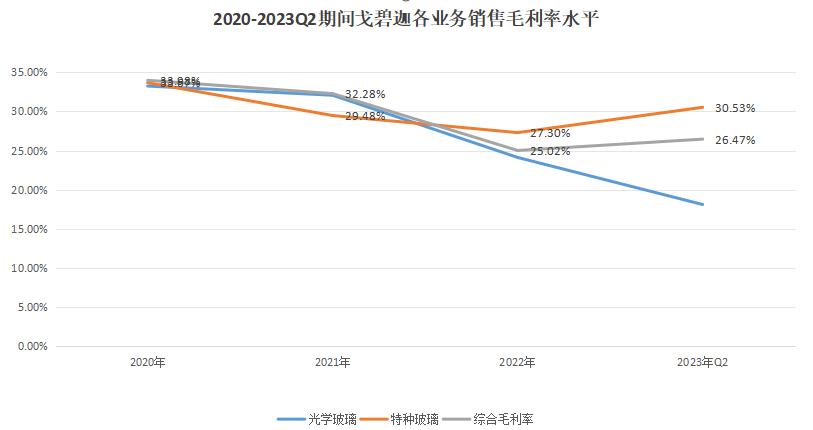
Looking ahead, in an era where intelligence has become a universal consensus, high-performance optical glass—thanks to its exceptional light transmittance, uniformity, and formability—is gradually emerging as a crucial element for driving intelligent innovation across a wide range of end-use applications, including smart consumer products, urban intelligent security systems, intelligent driver-assistance systems, and sports cameras.
Take the smart driving segment—the segment with the greatest growth potential in optical glass—as an example.
Intelligent driving comprises three systems: perception, decision-making, and execution. Among these, the perception layer has the greatest demand for optical components. For instance, in-vehicle cameras—often referred to as the “eyes of autonomous driving”—are the components in intelligent driving systems that most closely replicate human visual perception.
Therefore, as autonomous driving continues to evolve, its role is becoming increasingly prominent.
According to Yole data, smart vehicles typically equip no more than 4 cameras at Level 2 and below; at Level 3, they are equipped with 5 to 12 cameras; and at Level 4, they will be equipped with 13 or even more cameras. However, as the transition toward fully autonomous driving nears, the demand for cameras may decrease to around 9 units. At this stage, though, sensors—including cameras and LiDAR—incorporating optical components will see their per-vehicle value increase accordingly, driven by rising technical requirements.
According to data from ICV Tank and 360 Research Reports, the global automotive camera market is expected to reach US$27 billion by 2025, with a compound annual growth rate (CAGR) of 15.7% over the next four years. Among these, China’s market size will grow to RMB 23 billion, with a CAGR of 29.2%, indicating a promising outlook for the automotive camera market.
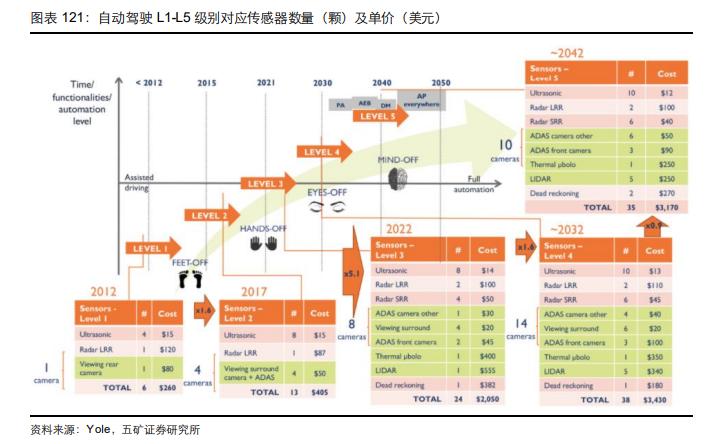
Among these components, optical lenses—including optical glass elements, filters, protective films, and the like—account for roughly 14% of the total value of automotive cameras. Assuming that half of this cost is attributable to optical materials, even without factoring in price increases, the market size for optical materials used in automotive cameras will reach 1.61 billion by 2025. According to incomplete statistics from the China Optical Optoelectronic Industry Association, the overall Chinese market for optical materials in 2022 was only 3.1 billion. According to Maolai Optics’ financial report, more than 70% of its optical materials are used in the smartphone sector.
If we also take into account the optical materials used in sensors such as lidar, the additional market scale driven by autonomous driving will only grow even larger.
In addition, the continuous upgrading and iteration of other smart consumer products such as AR/VR headsets and mobile phones, as well as innovative applications in industrial sectors—including high-performance fiber-optic communications, industrial automation, and machine vision systems—will further drive demand for high-performance optical glass.
In summary, especially as technologies and markets in these intelligent terminal sectors continue to achieve breakthroughs, the irreplaceable role of high-end optical glass and specialty functional glass will become increasingly prominent, thereby creating significant new structural growth opportunities for the industry.
Gobiga has also already positioned itself in these niche tracks with enormous potential.
On the automotive racing circuit, data shows that Gobiga’s aspheric lens products for optical headlamps entered BYD’s supply chain in June 2022. However, these products are still in the promotion phase, with most of them currently held in inventory. As a result, revenue from this business segment remains relatively small. The future outlook will depend on the effectiveness of subsequent promotional efforts.
However, in the smartphone sector—the segment with the largest current application scale—Gobiga may have already seized a small sliver of opportunity. The aforementioned changes in gross profit margin are precisely indicative of this situation, and the trend in revenue also reflects this point.
Continue analyzing further.
With a Huawei phone in the left hand and smart driving technology in the right, Gebiga is “casting a wide net” in the specialty glass sector.
Gobiga is currently in a period of rapid growth.
Data shows that from 2020 to 2022, its revenue achieved a compound growth rate of 38.67%. As of the first three quarters of 2023, its revenue reached 590 million, significantly exceeding the annual revenue of 429 million in 2022. Its net profit excluding non-recurring items doubled, rising from 40 million in 2022 to 82 million by the end of Q3 2023.
Upon closer examination of its revenue structure, we find that this may be closely linked to the commercialization of its high-end products. Data shows that the revenue share from its high-end specialty functional glass business has surged since 2022, reaching over half—specifically 66.7%—by Q2 2023. During the same period, the company’s overall gross profit margin also began to reverse its rapid downward trend.
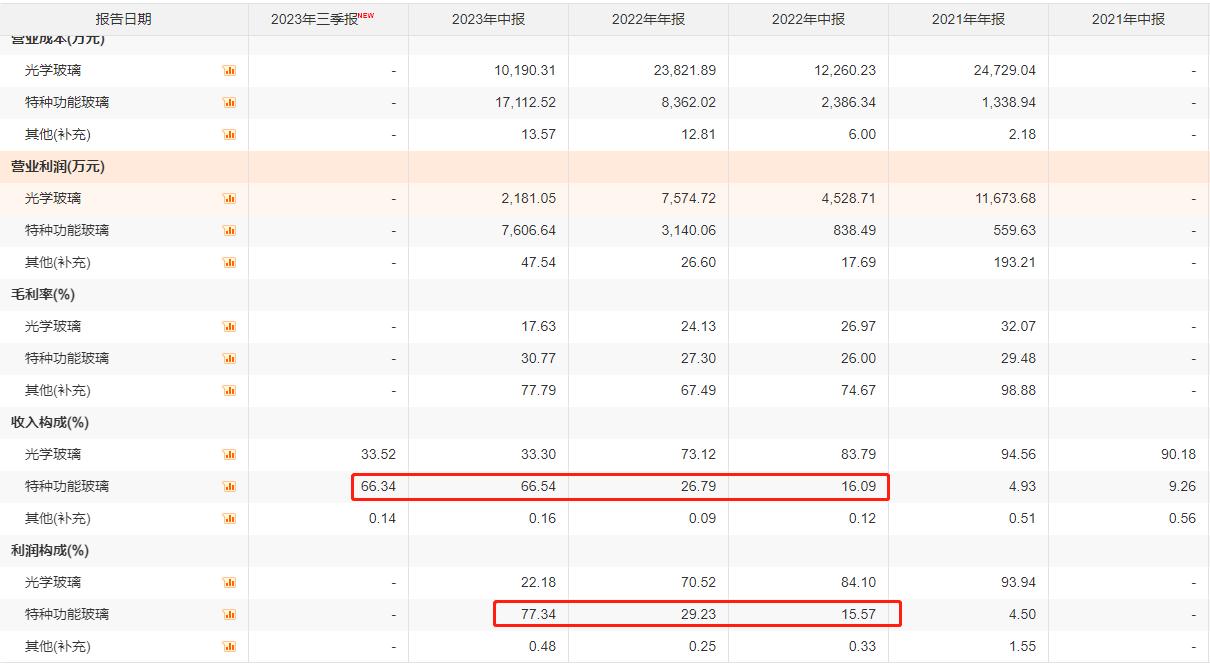
Source: Eastmoney Choice Terminal, Gobiga Prospectus
Further analysis reveals that this appears to be closely linked to Huawei’s return to the smartphone market.
In 2020, in order to match Apple’s ultra-ceramic glass panel, which boasts superior scratch resistance, Chongqing Xinjing Special Glass Co., Ltd.—a company invested in by Huawei—spent one year developing Huawei’s current flagship “Kunlun Glass” and has now achieved mass production. Currently, this glass is being used in mid-to-high-end models across the P50, Mate50, Mate60, and Mate X series.
And this “Kunlun Glass” should precisely be the nanocrystalline glass that Gobiga participated in developing and began mass-producing in 2021. According to its prospectus, Chongqing Xinjing is its exclusive customer for this nanocrystalline glass.

At the same time, the timing also happens to coincide.
After the launch of the Huawei Mate 50 in 2022, Gobiga’s revenue from specialty functional glass surged. At that time, Chongqing Xinjing became its largest customer, contributing 17% of its total revenue. In the first half of 2023, Chongqing Xinjing accounted for as much as 65.12% of Gobiga’s revenue. Therefore, in 2023, it is expected that after the release of the Mate 60 in the second half of the year, Gobiga’s revenue from this business will continue to grow further.
Although no official statement has been made yet, this newly developed “electronic glass”—nanocrystalline glass, hailed as the world’s most shatter-resistant—indeed presents significant opportunities for Gobiga.
It is reported that Chongqing Xinjing, recognizing the market potential of electronic cover glass—exceeding 100 billion yuan—is collaborating with relevant Chongqing authorities to plan and develop an electronic cover glass industrial park, aiming to attract companies from related industrial chains in regions such as Henan and Hubei to set up operations there.
By then, as one of the earliest companies to join this industrial ecosystem, Gobiga will find its room for imagination easily unlocked. In particular, in the fourth quarter of 2023, demand for smartphone upgrades and replacements—driven by brands such as Huawei—began to pick up, potentially further unlocking its growth potential.
However, viewed from this perspective, Gobiga will face the challenge of having relatively单一 revenue sources in the short term. It might be beneficial to make greater use of its commercial resources and newly developed products through a “wide-net” strategy across multiple sectors.
On the one hand, in addition to nano-microcrystalline glass, several specialized functional glass products—including radiation-resistant glass and high-temperature and high-pressure resistant glass—developed by the company have already achieved mass sales in fields such as healthcare, where there is a need for protection against environments with intense radiation, and in oil exploration, where conditions involve high temperatures and pressures.
But even more noteworthy is that, as mentioned above, Gobiga’s involvement in automotive fields such as autonomous driving has just begun—but the potential for this direction itself remains substantial.
According to available data, LightTech, a leading LiDAR company, is an investor in Gebi Jia and holds a 1.69% stake. Earlier, LightTech publicly stated that it would take it upon itself to strengthen and expand the laser display industry chain, striving to foster a healthy industrial ecosystem and empower invested companies to achieve sustainable, long-term value enhancement.
Going forward, as diversified new smart terminals accelerate their development, GoBeika may leverage the laser industry ecosystem of Guangfeng Technology to enter emerging fields such as smart cars, robotics, aviation displays, and AR, achieving breakthroughs in new markets and with new customers and thereby driving innovative revenue growth.
The six new production lines for specialized high-definition imaging optical glass materials that Gobiga plans to build through this IPO may well be part of its strategic move to enter the high-end smart-device market. Thus, we can envision that if this newly added high-end capacity is smoothly put into operation and Gobiga continues to win over new customers, the company will indeed have abundant opportunities ahead.
But such an outcome is by no means guaranteed.
Conclusion
It is clear that, as intelligent new technologies continue to evolve, optical components—being essential parts in most applications—inevitably keep pace with the changing times and technological advancements.
Therefore, although optical glass is a capital- and labor-intensive industry, for companies like Gobiga—still in the stage of scale accumulation—technological R&D remains critically important, as it directly determines their future growth momentum.
According to the prospectus, since 2020, Gobiga’s R&D expenditure has consistently remained at a relatively low level of around 5%. Meanwhile, considering that several of its patents have been invalidated or rejected since 2022, and given that Chongqing Xinjing and Nantong Shengping—companies that have made significant contributions to its performance—are likely to achieve technological breakthroughs in the future, they may eventually start producing nano-microcrystalline glass and radiation-shielding glass on their own.
Therefore, for Gobiga—a small and micro enterprise—placing the utmost importance on innovative product R&D and making proactive strategic plans is essential for growth.
However, overall, Gobiga’s business performance remains relatively reliable.
Perhaps the biggest challenge at present is precisely the relatively chaotic management issue mentioned earlier. While it’s not easy to build up a strong foundation in the first place, regardless of whether this IPO is successful or not, we hope that Gebijia will place even greater emphasis on scientifically reforming its management practices. After all, if you want to grow bigger and more reliable, sound management is absolutely crucial.