

News and Information
Photovoltaic glass remains pessimistic in 2023.
Photovoltaic glass remains pessimistic in 2023.
Release time:
2023-06-26
Source:
Reprinted from 36Kr
Author:
Friends at 36Kr
The reason for increased revenue but not increased profits is that last year both the prices of soda ash and natural gas remained stubbornly high, putting significant pressure on the cost side of photovoltaic glass. Although demand for photovoltaic glass has been robust this year, supply continues to expand substantially. Against the backdrop of oversupply, leading glass companies still face considerable pressure this year.
In 2022, Follett’s revenue grew by 77.44% year-on-year, yet its net profit increased by a mere 0.13%. The reason for this discrepancy—revenue growth without corresponding profit growth—is that last year both soda ash and natural gas prices remained stubbornly high, putting significant upward pressure on the cost of photovoltaic glass. Although demand for photovoltaic glass is robust this year, supply continues to expand substantially. Against the backdrop of oversupply, the leading glass manufacturer still faces considerable pressure this year.
01 Revenue increases but profits don’t—simply because costs are too high.
On the evening of March 27, Follett released its 2022 annual report, which showed that its operating revenue reached 15.461 billion yuan, an increase of 77.44% year-on-year; net profit attributable to shareholders was 2.123 billion yuan, up 0.13% year-on-year. Net cash flow from operating activities amounted to 177 million yuan, a year-on-year decrease of 69.49%. The annual report clearly highlighted Follett’s business performance last year: revenue grew, but profits did not.
As can be seen from the changes in the income statement, although revenue increased by 77% last year, operating costs surged by as much as 114% year-on-year. It’s therefore hardly surprising that the company ended up not making a profit.
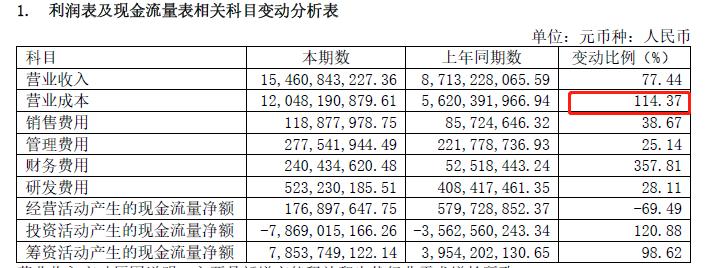
Why were costs so high last year? Mainly due to the substantial increase in raw material and energy costs.
In Follett’s core business structure, photovoltaic glass now accounts for nearly 90%. In 2022, the company’s gross profit margin for photovoltaic glass was 23.31%, with revenue increasing by 92.12% year-on-year. However, operating costs surged by as much as 129.11% over the same period. Among the cost components of photovoltaic glass, direct materials account for 40%, while fuel and power account for another 40%. The direct materials primarily include soda ash and ultra-white quartz sand—soda ash making up 50% and ultra-white quartz sand accounting for 25%. Fuel and power costs encompass heavy oil, electricity, and natural gas.
The price of soda ash rose steadily from January 2021 to November 2021, climbing from 1,400 yuan per ton to 3,800 yuan per ton. However, starting from the end of 2021, prices began to decline gradually. In 2022, the price of soda ash generally fluctuated around 2,700 yuan per ton, showing a relatively stable trend. Although the peak price in 2022 was lower than that in 2021, when averaged over the entire year, the cost of soda ash in 2022 still remained higher than in 2021.
In 2022, natural gas prices were significantly higher than in 2021, generally ranging from 6,000 to 8,000 yuan per ton, whereas in most of 2021, prices remained within the range of 3,000 to 5,000 yuan per ton.
So, looking at the big picture, we can understand why Follett saw revenue growth last year without a corresponding increase in profit. The revenue growth was driven by the upward trend in photovoltaic installations—just as water levels rise with the tide, revenue naturally expanded. However, costs were too high, ultimately leaving the company unable to turn a profit.
02 Oversupply persists, and photovoltaic glass remains stuck at the bottom of the cycle.
Due to their product characteristics, photovoltaic glass exhibits more pronounced cyclical behavior. Because photovoltaic glass products are relatively homogeneous and possess clear commodity-like attributes, the industry naturally experiences cyclical peaks and troughs as supply and demand become misaligned.
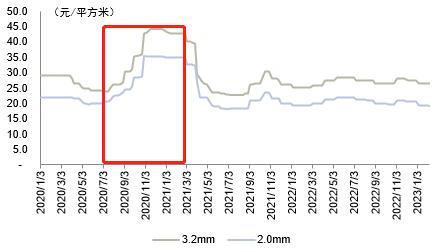
The most recent upward cycle in the photovoltaic glass industry ran from July 2020 to March 2021. During this period, the price of 2.0mm glass rose from 20 yuan per square meter to 35 yuan per square meter, while the price of 3.2mm glass climbed from 24 yuan per square meter to 44 yuan per square meter. Similar to the situation with silicon materials, this price increase was driven by a surge in photovoltaic demand at a time when production capacity was temporarily unable to keep pace with the growing demand, resulting in persistent price hikes due to supply shortages.
As companies in the industry accelerate production, leading glass manufacturers such as Follett and Xinyi continue to ramp up output and increase capacity. However, on the demand side, due to the sustained rise in silicon material prices—the key input for the main industrial chain—component manufacturers are under significant pressure, which has led to a reduction in their operating rates. As a result, demand has been somewhat restrained, and the upward price trend for photovoltaic glass did not last long. Consequently, after March 2021, prices rapidly entered a downward channel and gradually stabilized. Currently, the price of 2.0mm glass has stabilized around 20 yuan per square meter, while the price of 3.2mm glass has stabilized around 25 yuan per square meter. At present, photovoltaic glass prices remain roughly at these levels, with relatively little fluctuation.
Let's take another look at the supply and demand situation in the industry.
On the demand side, we assume that global photovoltaic (PV) installed capacity will reach 300 GW in 2023. Based on a capacity-to-module ratio of 1.2, the module demand will be 360 GW. We further assume that monocrystalline and bifacial modules each account for 50%. Specifically, we estimate that 1 GW of monocrystalline modules requires 47,000 tons of 3.2 mm glass, while 1 GW of bifacial modules requires 60,000 tons of 2.0 mm glass. Altogether, the total demand for PV glass next year is expected to be approximately 19.4 million tons.
On the supply side, similar to silicon wafers, after experiencing supply shortages from the second half of 2020 to the first half of 2021, photovoltaic glass manufacturers began fully ramping up production in 2021. Moreover, given the trend toward larger and thinner silicon wafers, the existing small kiln production lines for photovoltaic glass have become outdated and need to be replaced with new, larger-scale kiln lines. Coupled with the ramp-up periods of ongoing projects, substantial capacity will come online in 2022 and 2023. This year, the total effective supply—both domestically and internationally—is expected to reach approximately 25 million tons, indicating a very ample supply situation.
Therefore, Jianzhi Research (WeChat official account: Jianzhi Research Pro) believes that photovoltaic glass is currently still in the bottoming-out phase of a cyclical downturn, and for the next two to three years, the market will likely continue to experience a supply-demand imbalance, making it difficult to see any clear industry turning points in the near term.
As for the companies, the two leading players in photovoltaic glass are Xinyi Solar and Follett. Together, these two companies account for over 50% of the market share. Although the industry is currently at the bottom of its cyclical phase, the leading companies still enjoy distinct individual advantages. Among these, the most critical advantage for a cyclical industry is cost competitiveness. Because the leading companies benefit from economies of scale, their cost control is significantly better than that of smaller second- and third-tier enterprises, enabling them to maintain gross profit margins around 30%.
In short, Jianzhi Research believes that Follett’s revenue growth without a corresponding increase in profit in 2022 was actually within market expectations. However, regarding whether the company can reverse its profitability situation in 2023, Jianzhi Research remains skeptical—after all, at the industry level, supply remains relatively ample, and the turning point seems to be still some way off.